

Hearing about the attempted mass shooting at a mandir was really scary. Should we stay home this festive season?
In light of the recent attempted mass shooting at a Hindu temple in IL and the anti-Indian rhetoric exploding on social media, I’m concerned about attending pujas at the mandir, community garbas, and large Diwali parties. They are so important to me and my family but I’m genuinely worried about our safety. How do I navigate this?
Hey Scared. Your fear makes sense, and so does your love for these celebrations. You don’t have to choose between them.
The answer is to go prepared, to go together, and to keep our heads held high.
Kavita answers
Thank you for writing, and for naming something I know so many Hindu American families are quietly asking right now. I feel this fear too. Between this incident, and yet another shooting at an elementary school, there’s a lot to fear, and this is sitting heavy on so many of us, in so many ways. I recently wrote about being exposed to a torrent of online hate, and about how different the reality on the ground felt from what I saw on my screen. Part of what made that bearable was believing the hate would stay online. Learning that a jammed gun is what prevented a young man to carry out a mass shooting targeted at Indian Americans is alarming. Your worry isn’t an overreaction. It’s a reasonable response to something real.
It’s completely understandable to want to keep our heads down, skip the mandir, and wait out what feels like a storm of anti-Indian and anti-Hindu hostility. If, on a given night, your anxiety is too loud and you need to stay in, that’s allowed. One missed garba doesn’t make anyone less brave. But I’d gently caution against letting avoidance become the plan. As a psychologist, I know that avoidance shrinks fear in the moment and grows it over time. Each time we stay away, our nervous system learns two lessons: 1) the mandir was dangerous, and 2) staying home kept us safe. Before long, the places that hold us together start to feel like threats. That costs us, it costs our community, and it costs our kids, who are watching closely to learn what it means to be Hindu in America.
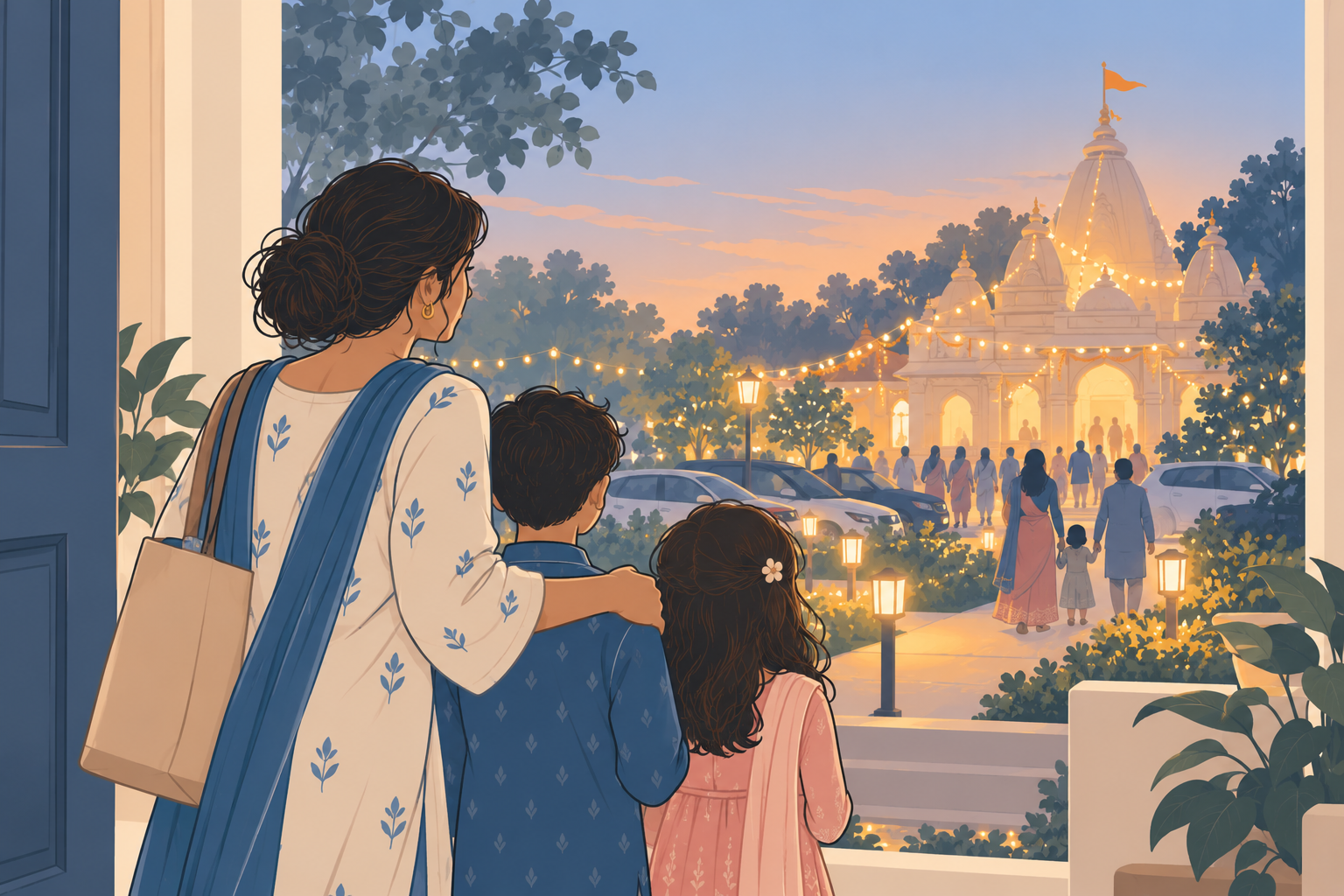
So instead of asking whether to go, I’d encourage you to ask how to go well. Being prudent and being present aren’t in conflict.
Start with a family plan. When you arrive somewhere, take a moment to notice where the exits are, and agree on a meeting spot in case you get separated. With kids, this can feel no more alarming than the plan you’d make at an amusement park.
Ask the organizers about security. For a garba or a big Diwali party, it’s fair to ask whether they’ve contacted local law enforcement. If they haven’t, you can call your local police department yourself so they know the event is happening.
Build the relationship before you need it. Use this moment to introduce your mandir and community to local law enforcement. You could even contact HAF to give a Hinduism 101 training to your police department, so the people protecting us understand who we are and what our gatherings look like.
Put the phone down. Much of the rhetoric online is designed to inflame. Stay informed through one or two reliable sources, then step away. Your nervous system needs the break, and so does your family.
Your kids may have heard about this already, or they will soon. Keep the conversation simple, honest, and matched to their age: something scary almost happened, someone noticed and spoke up, and lots of grown-ups are working to keep everyone safe. Then let your actions do the rest. Children take their cues less from what we say about fear than from what they watch us do with it.
Our parents came to an America that, in many ways, invited them to keep their heads down, assimilate, and accept some racism as part of life. They worked hard and proved themselves, and in doing so they made it possible for us to live with our heads held high. It would be easy to stay away from the mandir for the next few months, but we can’t cede our country to people who want us to live in fear, cut off from one another. It’s also worth remembering how this story actually ended. A coworker took the warning signs seriously and spoke up, and local police, working with the FBI, acted before anyone was hurt. That is the system working, and our continued engagement with it is part of what keeps it working for us.
There’s something fitting about facing this during Navratri. For nine nights, we celebrate Durga, who meets threats head-on. In so many depictions, one of her hands is raised in abhaya mudra, the gesture that means “do not fear.” It isn’t a promise that nothing frightening exists. It’s a reminder that we don’t face it alone. Garba carries the same message: we dance together, in a circle, around embodiments of Shakti. We owe it to the generations before us, and to our children, to keep stepping into that circle wisely, with our eyes open and our heads held high.
Happy Navratri, and an early Happy Diwali. Please enjoy celebrating with your kids.
Have a question of your own?
Anonymous, paraphrased, answered here.
