

My children attend our town’s public high school. The school has a South Asian Student Association that organizes an annual combined celebration for Diwali and Garba. This year, the theme was advertised as “Arabian Nights.” I’m not happy with it, but I also don’t know if I’m being overreactive.
Hi, Unsure. No, you’re not overreacting.
Noticing that your culture is being blurred into someone else’s isn’t oversensitivity; it’s paying attention.
The real question is what to do with that feeling, and the best place to start is with your kids.
Kavita answers
Thank you for writing, and for trusting a feeling that so many of us learn to talk ourselves out of. Growing up as a minority, many of us were taught, quietly, to second-guess our discomfort. We wonder if we're being too sensitive, or if speaking up will make us "that parent." But noticing that something is off about how your culture is represented isn't overreacting. It's a reasonable response to something real. I can really resonate with the part that wants to play along, and just appreciate that our culture is being shown at all, whether it’s a controversial Apple ad, or smiling when my former prek4 students put glue dots on their heads randomly. But this one stings, and we can unpack why that is.
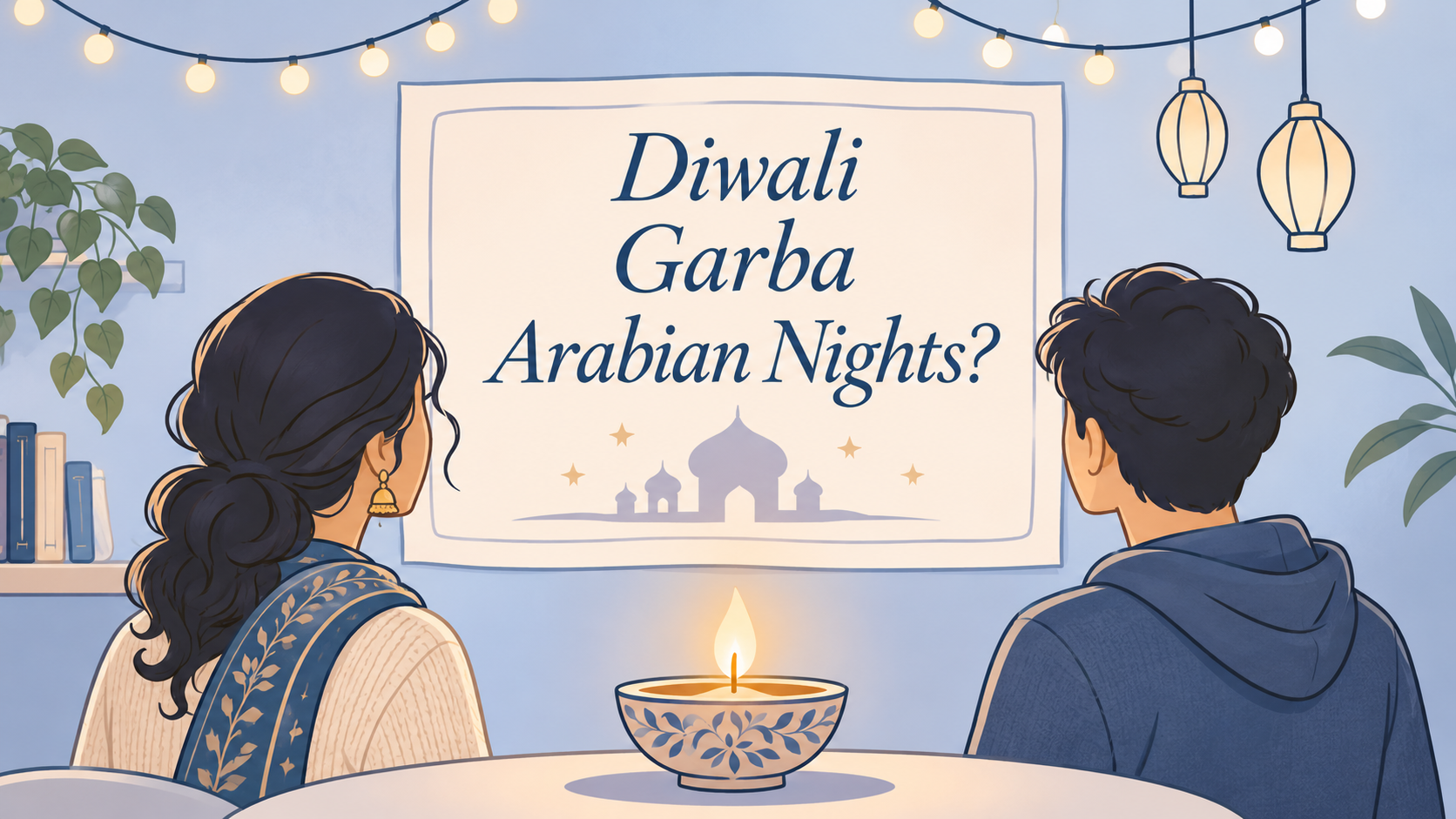
It blends cultures that are distinct. Diwali is a festival of lights celebrated by Hindus, Jains and Sikhs. Garba is a devotional dance from Gujarat, performed during the Hindu festival Navratri in honor of the Goddess Durga. "Arabian Nights" points somewhere else entirely, to a collection of Middle Eastern and Persian folk tales. Pairing them suggests that "the East" is one interchangeable aesthetic, which is exactly the kind of blurring a cultural student association exists to push back on.
It draws on a fantasy, not a culture. As a party theme, "Arabian Nights" usually means genies, flying carpets and Aladdin: a long Western habit, which scholars call Orientalism, of treating Eastern cultures as exotic and mysterious. So the theme doesn't really honor Arab culture either. For Arab and Muslim classmates, it can feel like their heritage has become a costume for someone else's celebration.
It can hollow out what's sacred. Diwali and Navratri aren't only parties. They carry real spiritual meaning: inner light over spiritual darkness, Durga's victory over evil, renewal and gratitude. A theme can add fun. When the theme overshadows the festival, the meaning gets lost, sometimes even for the South Asian students who are still learning about these celebrations.
At the same time, it's very likely the students who chose this theme meant well. They were probably drawn to the lanterns, gold and glamour. Maybe "nights" even felt like a nod to a festival of lights. Good intentions and a theme that misses the mark can both be true. Many second-generation teens are absorbing their culture through a mix of family, friends and pop culture, and they're still figuring out where one ends and the other begins. Coming in with curiosity rather than criticism keeps the door open.
So instead of asking whether to say something, I'd start by asking your kids. This is their school and their social world, and their perspective matters most here.
Ask how they feel. Keep it open: "What did you think when you saw the theme?" Some teens will share your discomfort. Others won't have noticed, or may have been excited. Try to listen before steering them toward your view.
Gauge their appetite for addressing it. Some kids will want to speak up. Others will want to enjoy the event and move on, especially if they're worried about seeming difficult among friends. Your job is to find a balance between encouraging them to use their voice and accepting where they are. Even if they aren't ready to act, you can share why it bothers you, so they have the reasoning to come back to later.
If they want to act, help them choose a step that fits. A friendly, private message to the association's student leaders usually lands better than a public complaint. Offering alternatives helps more than objections alone: a "Festival of Lights”, "Navratri Nights", or “Nine Nights of Lights” theme, or one built around a particular region's traditions. They might also suggest a short moment at future events explaining what Diwali and Garba celebrate; HAF's Hindu holidays guide is a good starting point. If they want backup, they can bring in the faculty advisor, ideally with them leading the conversation.
Be their coach, not their spokesperson. Going to the school over your kids' heads can put them in an awkward social spot. Helping them find their own words builds a confidence that will serve them long after this event. And if the celebration has already happened, this becomes a chance to shape next year rather than reopen this one.
Whatever they decide, show them they can hold both feelings. They can dance, celebrate with friends and enjoy the night, and still believe the theme missed the mark. Learning to hold joy and critique together is very Hindu, and is one of the most useful things a young person in a minority culture can learn.
There's something fitting about this question arriving at Diwali. The Brihadaranyaka Upanishad offers a prayer many of us grew up hearing: asato ma sadgamaya, tamaso ma jyotirgamaya, "lead me from the unreal to the real, from darkness to light." A themed fantasy, however beautiful, is a kind of unreal. What our kids deserve is the real thing: the stories, the devotion and the meaning behind the lamps and the dancing. And like a diya that lights another without losing any of its own flame, sharing our culture accurately with classmates doesn't take anything away from the celebration. It makes the light go further.
Happy belated Diwali to you and your family. I hope your kids find their own way to keep that flame lit.
