

“My partner wants me to convert. Is it really a big deal?.”
“I’ve been dating someone seriously for about a year, and things feel pretty perfect. We have the same interests, we communicate really well, we’ve built community with our mutual friends. We’re both ambitious, and we’re able to really give each other space to thrive. It really feels like we make each other better. But… it came up recently that he’s hoping I’ll convert to his religion to help him keep the peace with his family. Religion isn’t a big part of either of our lives, so he dropped it pretty casually as a formality for getting engaged. I know I love this guy and I’m surprised by how much this is bothering me. What should I do?”
Kavita answers
Connecting with someone you can build such a positive relationship with in 2026 can feel so rare. Magical even. I can really appreciate how many conflicting feelings it brings up to have built a relationship that feels so perfect and healthy, minus this big question. I can imagine you can absolutely find people in your life who will tell you that if you have someone you can build an actual life and future with, converting as a formality shouldn't be a "big deal." I'm also pretty sure you have people in your life who would be really irate that you even started dating a man from another religion in the first place. I'll be upfront that I don't think there's a clear right or wrong answer here, but I want to give you some things to think through that might help you gain clarity about what YOU want — not should, not need, but want — to do in this situation.
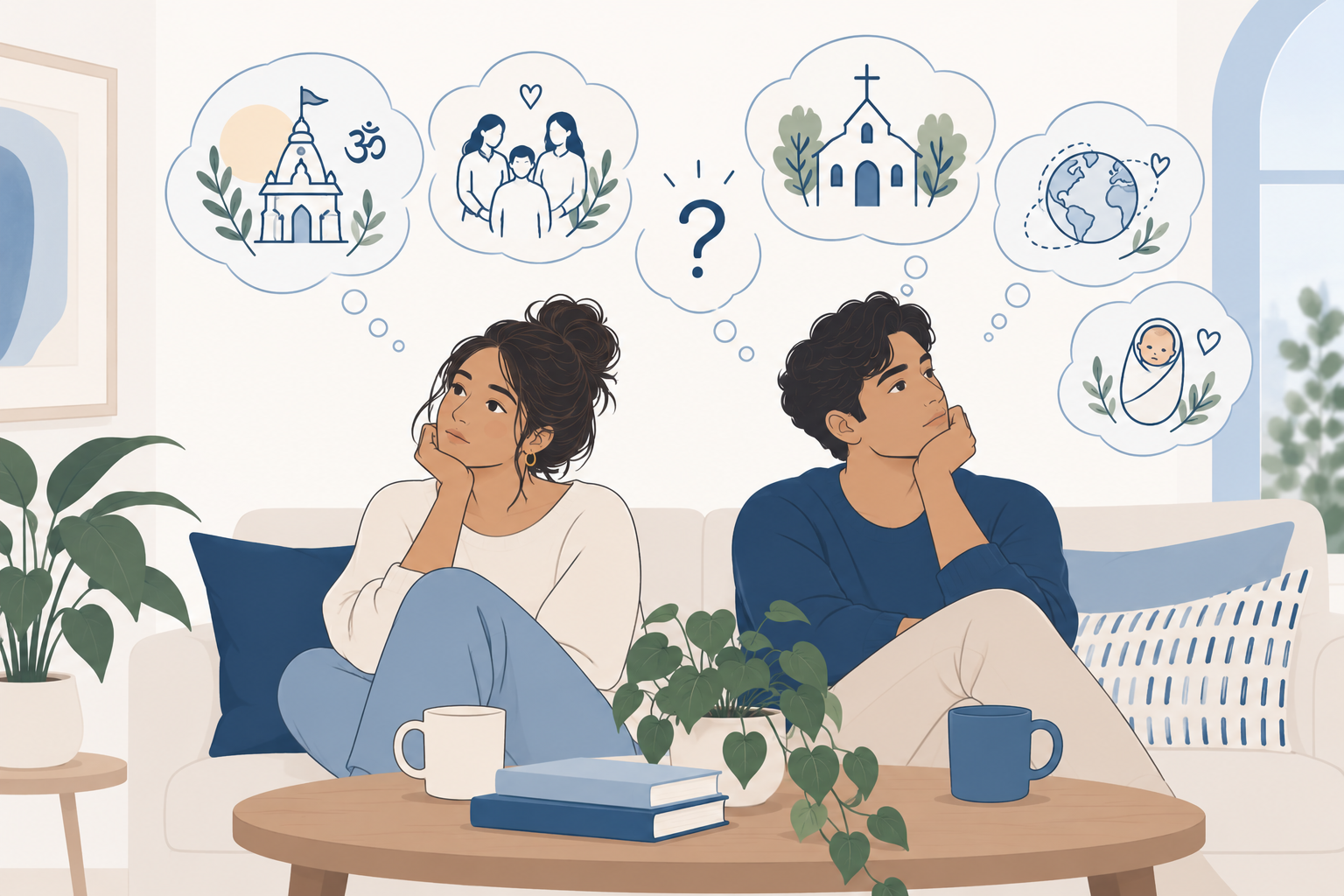
Interfaith couple contemplates the challenge ahead of them.
Let's start with something a little unusual for a question about religion: Hinduism itself doesn't actually give you a template for this, and that's worth sitting with. Unlike traditions built around a single path to the divine, Hinduism has never had a formal doctrine of conversion in either direction — you aren't born into a Hindu obligation to bring someone else into “the fold”, and there's no ritual requirement that says a partner must join you in belief for a union to be legitimate. The concept of ishta devata, the personal or "cherished" deity each person is free to choose for themselves, reflects something the tradition has held for a long time: that the path to the divine or Self discovery is understood as personal, not standardized, and that plurality of practice within a household has never been treated as a crisis. That doesn't tell you what to do here — but it does mean that if part of what's nagging at you is a sense that "conversion keeps the peace," is something counter to how you see the world. People from Dharmic traditions who marry people from Abrahamic traditions often struggle to really grapple with what conversion means to each side of the argument. There’s a space to say that a “conversion” won’t change your Hindu heart and mind, so picking “keeping the peace” costs you nothing. There’s also space to say that this fundamentally asks you to reject yourself, your roots, and your spiritual compass - even if you’re not praying daily, going to the mandir every week, or reading scripture on the regular, you may realize that Hindu dharma has transfused your life in more ways that you’ve thought about.
Now, the direct part: marriages between people of the same religious background tend to hold together more often than interfaith ones. If zooming out to see other people’s relationships is helpful, it’s important to acknowledge that this is a real pattern shaped by many factors. Some who go into an interreligious relationship thinking that religion isn’t important to them, find that having a child changes how they see their relationship to faith immensely. The toll of family, in-laws, or community being rejecting can be intense. Who we are and what we value changes as life throws lemons and lemonade at us, and for many, falling back on the grounding we received as children is deeply appealing. Quite simply, it can be harder to make an inter-religious relationship work. For you, dear Conflicted, thinking through if you want children, how they’ll be raised, and how much you’ll really be asked to stretch to “keep the peace” will all be important parts of really unpacking why this is bugging you.
Stats are stats, and they can't determine how your relationship will evolve. There are millions of couples who thrive in their interreligious marriages in this country, and their children thrive as well. The keys we've seen in these relationships come down to three things — transparency, respect, and acceptance. Transparency works on two levels: being really honest with yourself about what you believe and what you want, and being honest with your partner. If there's a part of you that feels like conversion would require you to reject a part of yourself you cherish, you owe it to yourself and to your partner to say that it doesn't feel like a small adjustment or formality you can casually accept. Respect is foundational — couples who see each other as unequal in any way are the most doomed to fail. It sounds like you're particularly grateful for the respect you show each other in your careers, and I'd guess that respect is a big part of what makes this relationship feel so good to you. How is the ask to convert playing into that feeling? Acceptance is about really seeing your partner and your life, and being able to accept what you can't control. It doesn't always mean agreement, and sometimes it doesn't even mean understanding, but it is crucial that to build a relationship, you have to fundamentally feel like you choose it, want it, and are going to keep choosing it. Sit with how accepted you're feeling right now, and what you're actually willing to stretch toward to keep this relationship — versus what would just be swallowing something to keep the peace.
Communicating transparently, with respect and acceptance, is the key to any relationship. It takes work, but it can be built.
One more thing, since I raised it earlier and don't want to leave it hanging: the people in your life who'd be upset you're even in this relationship are not a small factor here, and I don't think you should pretend they are. Their disapproval doesn't get a vote in your decision, but it will be part of the weather you live in either way — whether you convert or you don't, whether you marry him or you don't. That's worth naming honestly rather than hoping it resolves itself once the wedding is over. Ask yourself what support you'll actually have, from whom, and whether you and your partner have talked about how you'll face that together. A relationship this solid can absorb a lot. It shouldn't have to absorb it silently.
I hope this is helpful. I'm sorry it's feeling tough and confusing. The good thing about no right answers is that there isn't a wrong one either — how your life looks will only be a function of you making the most of whatever you decide. Good luck!
Have a question of your own?
Anonymous, paraphrased, answered here.
