

How do I talk to my kids about sex? I have 2 girls (pre-teens). I grew up here, but my parents never gave me the “birds and the bees” talk. It was one of those things you didn’t talk about. My parents are very Hindu. I’m Hindu-ish… very non-practicing, bare minimum type of stuff. Divorced. Our kids’ mom is not Hindu. Do I let their mom talk to them about it? What’s my role here? Is there any advice I can give from a Hindu perspective?
Hi Girl Dad. I’m so proud of you for not just quietly handing this one off to Mom, and for writing in instead.
Hindu teachings have a lot to offer here, and the fact that you want to be honest with your girls is already the best possible start.
Kavita answers
I’m gonna be honest with you, Girl Dad, and all readers: I read this and went “eep.” My kids are 6 and 4, and I haven’t really thought about this yet! The conversation I had with my mom right before I got married still makes my whole face flush red, and it was four lines:
Mom: Kavita, you watch your American movies and stuff, right?
Kavita: What??
Mom: Kavita, you watch MOVIES, right? We don’t need to talk about your wedding, RIGHT?
Kavita: NO ABSOLUTELY NOT I WATCH MOVIES WE CAN BE DONE.
There are a lot of reasons talking about sex makes so many of us uncomfortable. Sex asks for an immense vulnerability that’s hard to put into words. And many of us are still carrying Victorian, colonial-era attitudes more than a century later, even though our own traditions historically had a very, very different approach. Vatsyayana’s Kama Sutra is probably one of the most misunderstood and misreferenced Hindu texts, but it offers a really beautiful picture of the openness to sex, sexuality, and gender that exists in a wisdom tradition founded on experiencing truth rather than absolutism.
It makes SO much sense if this is bringing up feelings, and if part of you is wondering whether you can just leave it to Mom. But you wrote in because you want to do it differently than it was done for you. Let’s talk about how.
What our tradition actually says
Hindu traditions name four aims of a human life: dharma (living rightly), artha (security and prosperity), kama (desire, pleasure, love) and moksha (liberation). Kama is on that list. Our traditions recognize desire and pleasure as a legitimate part of being human, not something shameful. The Kama Sutra exists precisely because our ancestors were willing to write about this openly and thoughtfully. Hindu traditions also offer the idea of four stages of life that balance these four aims in different ways. The brahmachari stage is the first, and emphasizes study and understanding of Hindu dharmas to build life skills. The second is the grihasta stage, where one is meant to focus on building their home, family, and career. Vannaprastha encourages individuals (who may now be retirees and grandparents) to start letting go of attachment to the material world. The final ashram is sannyasa, where individuals are asked to complete the work of the previous stage to work towards moksha, and full renunciation of the material life.
Understanding that Hinduism can hold pleasure and purpose together, can help you unpack how making values aligned decisions looks for your kiddos. Kama is a goal, AND it was never meant to stand alone. It’s held in balance with dharma (determined in part by our stage of life), with our values, our responsibilities, and how we treat ourselves and others. That’s a beautiful framework to hand your daughters: your body and your desires are not shameful, and you get to make choices about them that line up with our shared values. Values bring up short term goals and long term goals, and really unpacking how sex sits in that framework takes reflection. Add ahimsa, the principle of non-harm, and you have the heart of consent. We don’t cause harm, and we don’t accept harm. Nobody touches you without your yes, and you never touch anyone without theirs. What it means to say yes is complicated, but really thinking about what you’re gaining, giving, and risking is really important. To be explicit, the gains can be pleasure and commitment and reinforcement of a relationship, the giving can be trust and vulnerability. The risks are pregnancy, disease, and ruptures to a relationship if stability, trust, and commitment haven’t really been established, amongst others. Hindu teachings have much to say about the karma of sex, and the impact of sexual experiences on our energy and our physical, emotional, and mental wellbeing. I hope that this offers a starting point to consider the impact of a very important decision.
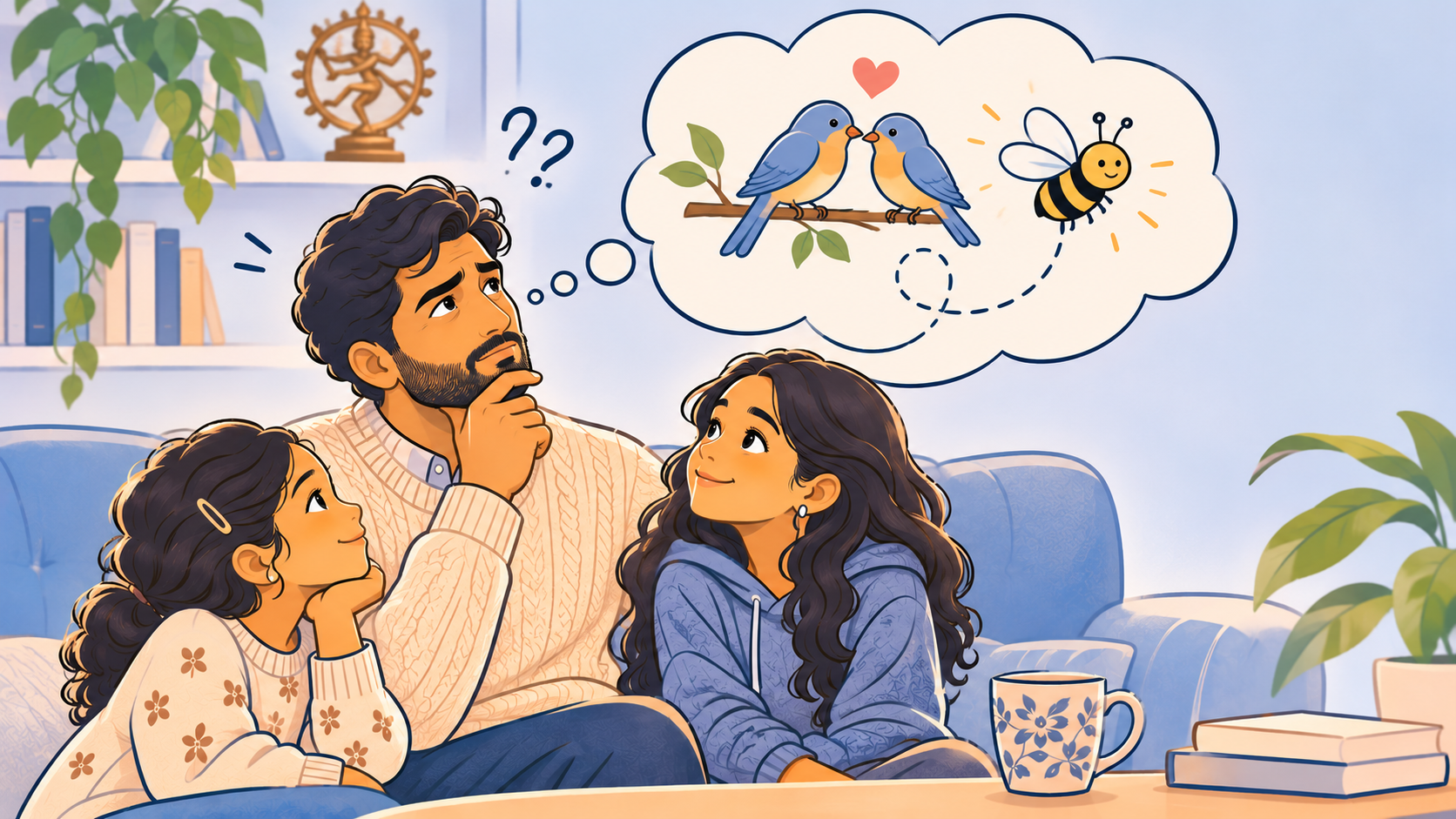
Sex means incredibly different things to different people, and in order to understand what you want to convey to your daughters, you’re going to need to think through what you value in the first place. This is your opportunity to model the whole process for your daughters, and to remember that the immediate discomfort that’s typical to feel around this conversation belies so many things you want them to know about sex, themselves, and the way the world works. If you want to emphasize the value of abstinence before marriage you absolutely can do that. If it feels more nuanced, you can lean into that. You don’t need to be practicing to share any of this. Hindu-ish is plenty.
Your role (yes, you have one)
This isn’t a choice between you and their mom. Your girls will be best served if both of you are people they can ask. If you can, have an intentional conversation with their mom about the shared message you want to convey, like the facts, safety, and your core values, so the girls aren’t hearing totally different things in two homes. Her not being Hindu doesn’t change any of that. You’ll each bring something.
And Dad, a father who can say “period” or “puberty” without flinching is a real gift to pre-teen girls. Your comfort tells them their bodies aren’t embarrassing.
How to actually do it
Suspend your judgment. We know these are hard conversations to have, and it’s natural to have a spike of emotion when it comes up, but do your best to show up curious and open minded about what they’re saying and doing, of course, but also what’s under it.
Skip “The Talk.” Have lots of small talks. Car rides are great. No eye contact required. When you’re open to the opportunity, you’ll see small chances to build on what they’re sharing, their body language, or even your own experiences that you want to share.
Use Pop Culture: Movies, moments in class, and other moments “in the wild” are all opportunities to start conversations. You also get to think about the themes you’re most concerned about, and find ways to introduce them with real world/fictional world examples. Beauty and the Beast has openings to talk about coercion, the Ramayan creates space to unpack commitment and consent, and every Taylor Swift lyric about love, heartbreak, and growth is your friend (so many psychologists have spoken about Patient Zero particularly being an incredible understanding of narcissistic abuse).
Start where they are. At their age, that means puberty and bodies first, then consent and boundaries, then relationships and values. Have a sense of when these conversations are starting formally in school in sex-ed class, and build from there.
Use real words. Correct names for body parts protect kids and take the weirdness and discomfort out.
Answer what’s asked. You don’t have to cover everything at once. “That’s a great question. Let me think about it and get back to you” is a complete answer, as long as you do get back to them. Chances are your daughters may not be the ones starting these conversations with their questions, but your commitment to noticing and naming these things will help get the ball rolling.
Set appropriate limits. Protecting your daughters is absolutely part of your dharma as their father. That includes setting limits as they get older. Openness doesn’t undo that. It makes it work. When you push yourself to know why you’re setting the limit, instead of simply enacting your reflexive response, you’ll be able to communicate them in ways they can understand and abide by.
Say the quiet part out loud: “You can ask me anything, and I won’t be mad.” Then prove it. If you can really prove that in a bind, support will come before rage or shaming, you’ll foster both the independence and the ability to provide the safety that you want. “Your safety is the most important thing to me, even if you broke a rule to get there” is a really powerful sentiment to be able to share.
Remember, the goal is for you to be the person they come to before they go to the internet or a friend. Your silence won’t keep them safe, but your availability just might.
You’ve got this, Girl Dad.
